Review: Everything is Tuberculosis
5/5 stars
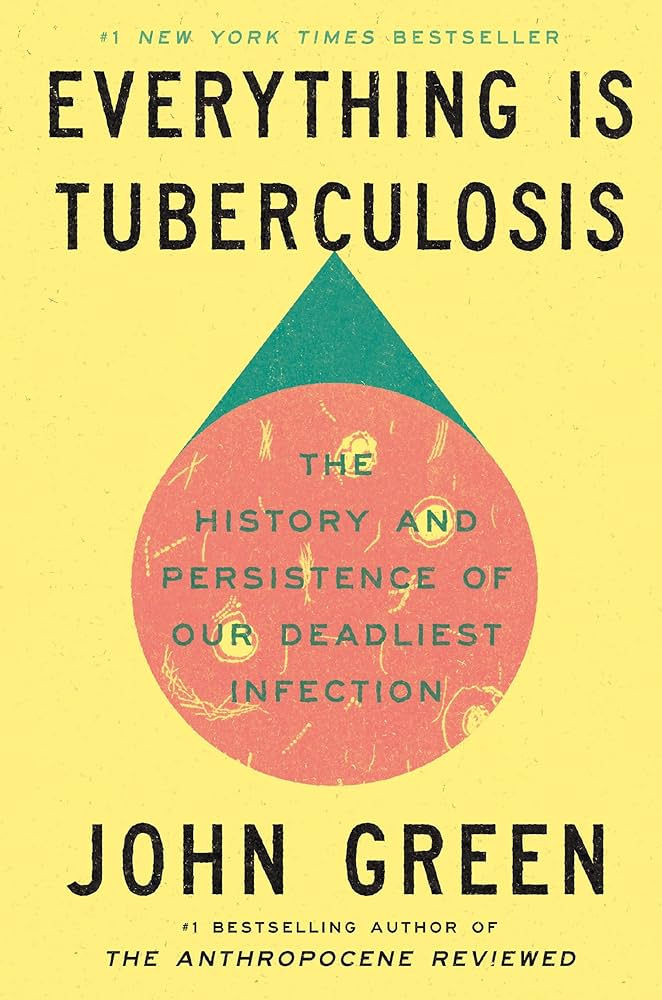
Everything is Tuberculosis: The History and Persistence of Our Deadliest Infection, by John Green (2025)
"People who are treated as less than fully human by the social order are more susceptible to tuberculosis. But it's not because of their moral codes or choices or genetics; it's because they are treated as less than fully human by the social order."
Only John Green could make the history of tuberculosis, the world’s deadliest infectious disease, interesting, topical, and moving. Green's perspective is always unique, and his voice is always solid and logical and incredibly, wonderfully human. And it doesn't hurt that he's an amazing wordsmith.
At the center of this book is a boy named Henry. Henry who lives at a tuberculosis (TB) clinic in Sierra Leone, who shares a name with Green's son. Henry who looks the same age as Green's son at the time - around 9 - but is actually 17, having been stunted and ravaged by TB since the age of 6. Green makes a deep connection to this young man, and thus embarks on a many-years-long exploration of TB in relation to race, fashion and beauty, stigmatization, wealth and power - or lack thereof - and, of course, politics.
It's an amazing journey through all the ways TB has shaped history, from small things, like the creation of the cowboy hat, to medium-sized things, like the creation of the state of New Mexico, to much larger things, like, oh, I don't know, the spark that lit the flame that started World War I (to quote Green, "Did you know that tuberculosis sorta kinda but not really caused WWI?"). Green expertly takes the reader through past and present, illuminating history from the perspective of the sick and dying, and those who are providing or denying care.
I found his exploration of "consumption" - what TB was called before the discovery of bacteria - particularly interesting. When it was a disease contracted by mostly white people, the pale skin and flushed cheeks of consumption were heavily romanticized as poetic and beautiful; the sign of a gentle soul. When the disease began to spread widely in non-white communities, the meaning attached to it shifted dramatically. Linked to other "devalued" characteristics, TB became the degenerate's disease.
Here is a quote pulled from Vonnegut's novel, Cat's Cradle:
Tiger got to hunt
Bird got to fly
Man got to sit and wonder, "Why, why, why?"
Tiger got to sleep
Bird got to land
Man got to tell himself he understand.
Which Green follows with:
"Even when there is no evidence of a clear link between character and illness, we will invent one: It was long believed, for example, that cancer resulted from social isolation, or from bottling up one's feelings. Even when these explanations are cruel and dehumanizing, we embrace them - because tiger got to sleep, and bird got to land, and man got tell himself he understand."
Green points out frequently that “tuberculosis is wherever the cure isn’t, and the cure is wherever tuberculosis isn’t.” His critique of the political forces that allow a curable disease to continue to run rampant in developing countries is cutting and realistic, but hopeful. At the close, he leaves us with a charge:
"We cannot address TB only with vaccines and medications... We must also address the root cause of tuberculosis, which is injustice. In a world where everyone can eat, access healthcare, and be treated humanely, tuberculosis has no chance. Ultimately, we are the cause. We must also be the cure."
UP NEXT: An Absolutely Remarkable Thing and A Beautifully Foolish Endeavor, by Hank Green


Comments